
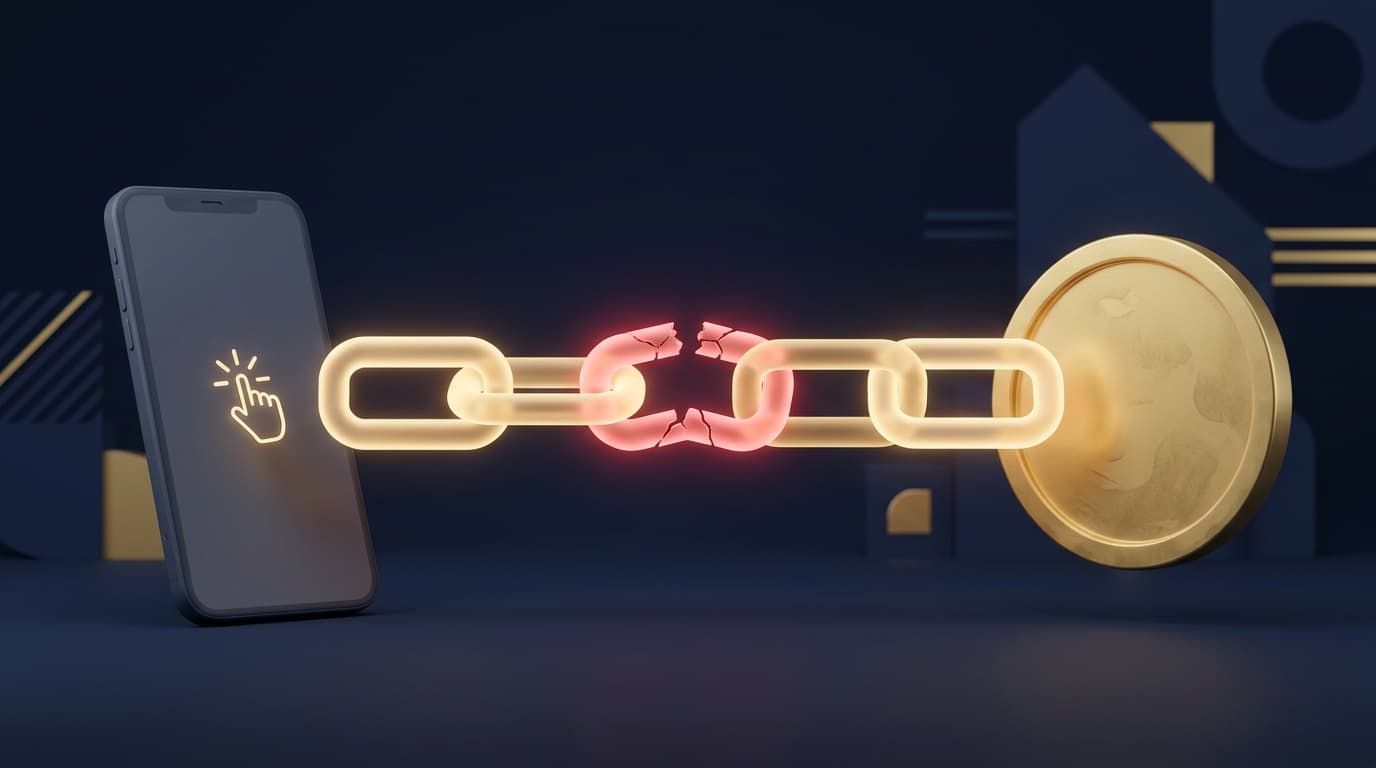
- Offer crediting depends on an attribution chain with three or four parties — your click fires a tracking link, a partner network sets an identifier, and the advertiser confirms your action against it. Break any link and you complete the offer invisibly.
- The seven chain-breakers are ad blockers, VPNs, private browsing, device switching, installing outside the offer link, completing requirements before clicking, and denied iOS tracking permissions — all preventable, none fixable after the fact.
- Completed is not the same as credited. You see your own progress instantly; the platform only sees what the advertiser confirms and pays for, which is why pending periods exist.
- A five-step pre-offer checklist — clean browser, no VPN, one device, one session, screenshot the terms — prevents nearly every self-inflicted tracking failure.
You did everything right. Installed the app through the link, reached the level, finished the signup. The confirmation screen appeared. And your balance did not move.
Every rewards platform has a version of this complaint, and almost every version has the same root cause: somewhere between your click and the advertiser's payment, the attribution chain broke. We have written platform-specific fix guides for Swagbucks and Mistplay — this is the guide underneath those guides. Once you understand how tracking actually works, missing credits stop being mysterious and start being preventable.
TL;DR: Quick Answer
- Why offers fail to credit: your click fires a tracking link that sets a digital identifier; the advertiser confirms your action against that identifier. If the identifier was blocked or lost, your completion is invisible — to every party involved.
- What breaks it: ad blockers, VPNs, private browsing, switching devices mid-offer, installing from the app store instead of the offer link, completing requirements before clicking, and denied iOS tracking prompts.
- Can it be fixed afterwards? Almost never. Attribution either happened at the moment of your click or it did not. Prevention is the only reliable strategy.
- The habit that prevents it: complete every offer in one sitting, on one device, in a clean browser, with no VPN and no blockers — and screenshot the offer terms before you start.
What Tracking Actually Means
Offerwalls are advertising. An advertiser — a game studio, a subscription service, a finance app — pays for new users and completed actions. The offerwall is the marketplace where that budget gets turned into tasks, and the rewards platform is where you see them.
"Tracking" is how the advertiser knows which marketplace, which platform, and which user produced a given action. It is the bookkeeping layer of the entire rewards industry. When it works, money flows backwards down the chain: the advertiser pays the offerwall network, the network pays the platform, the platform credits you.
When it does not work, the same chain produces the most frustrating outcome in this hobby: you genuinely completed the task, the advertiser genuinely got a new user, and nobody got paid for it — because nobody can prove the two events are connected.
The Journey of One Offer Click
Here is what actually happens when you tap an offer, in order:
- The click. Your tap fires a tracking link — a redirect through the offerwall network's servers that records the time, the offer, your platform account, and a device identifier.
- The handoff. The network forwards you to the destination — an app store page, a signup form — and attaches its identifier so the advertiser's measurement system can pick it up.
- The match. When you install the app or create the account, the advertiser's attribution system checks: did this new user arrive from a tracked click? If yes, the conversion is attributed to the network, the platform, and you.
- The confirmation. When you complete the payable action — opening the app, hitting the milestone, finishing the paid signup — the advertiser's server notifies the network, which notifies the platform. This server-to-server message is called a postback, and it is the only signal your platform ever receives.
- The credit. The platform receives the postback and credits your account, immediately or after a holding period, depending on the offer.
Notice what this means: the platform you earn on never watches you play the game or fill the form. It cannot see your progress at all. It sees exactly one thing — postbacks. If the chain broke at step 1, 2, or 3, no postback will ever arrive, no matter how thoroughly you completed the task.
Why Completed Is Not the Same as Credited
This is the mental model shift that explains nearly every missing-credit complaint.
You experience the offer from inside: you watched yourself reach level 30, so you "completed" it. The platform experiences the offer from outside: it either received a postback for your level 30, or it did not. Those are different events, separated by an attribution system you cannot see and several confirmation steps you do not control.
Three practical consequences:
- Proof of completion is not proof of attribution. A screenshot of your level proves you did the work. It does not prove the advertiser's system connected that work to your click. Support teams need the click record to exist before any proof matters.
- The advertiser decides what counts. If the offer said new users only, or required a purchase, or set a deadline, the advertiser's system enforces those rules mechanically. A near miss produces no postback and no explanation.
- Delays are confirmation schedules, not platform stalling. Postbacks for installs fire in minutes; postbacks for trials fire when payment clears; postbacks for purchases fire after return windows. The platform is waiting just like you are.
The Seven Ways Tracking Breaks
Every tracking failure we have ever traced lands in one of these seven buckets.
1. Ad blockers and privacy extensions. Tracking links look exactly like the advertising requests these tools exist to block, because that is what they are. uBlock, AdGuard, Brave shields, and strict tracking protection will sever the chain at the click, silently. This is the most common cause on desktop.
2. VPNs and proxies. Offers are targeted and priced by country. A VPN creates a three-way mismatch between your account country, your IP, and your device locale. Attribution fails, and most platforms additionally flag the account, because faked locations are the industry's biggest fraud vector. This includes always-on services like iCloud Private Relay.
3. Private browsing and cleared cookies. Browser-based attribution lives in cookies and session storage. An incognito window destroys the identifier the moment it closes; clearing cookies mid-offer does the same. Multi-day browser offers need a normal window that you do not clean in between.
4. Switching devices or browsers mid-offer. The identifier lives on the device and browser where you clicked. Click on your laptop, complete on your phone, and the advertiser sees an arrival with no tracked click. The whole flow has to happen where the click happened.
5. Installing outside the offer link. Seeing a game on the offerwall, then installing it by searching the app store directly, produces an organic install — attributed to nobody. Worse, your device is now flagged as an existing user of that game, which usually disqualifies it from the offer permanently. Always install through the offer button.
6. Wrong order and reattribution. Attribution starts at your click, so completing a requirement before clicking — installing the app first, opening the account first — produces nothing. And because most systems credit the last click, clicking a coupon site, comparison site, or another platform's link after the original click hands your attribution to them. One offer, one click, one sitting.
7. Denied tracking permissions on iOS. App Tracking Transparency lets you refuse the device-level attribution that install offers depend on. Deny the prompt and the install frequently cannot be matched to your click. If you do install offers on iPhone, tap Allow — or stick to browser-based offers where the app permission is irrelevant.
What is conspicuously absent from this list: platform glitches. They exist, but they are rare compared to the seven above. The uncomfortable truth of missing credits is that most of them are self-inflicted, by setups that are perfectly sensible everywhere else on the internet.
Why Pending Periods Exist
Pending credit frustrates people almost as much as missing credit, so it is worth explaining what it actually is.
When your credit shows as pending, attribution worked. The click tracked, the postback arrived, you are in the system. What has not happened yet is final confirmation — the advertiser reserving the right to reverse the conversion if it turns out to be fraudulent, refunded, or fake.
- Game offers pend while the advertiser screens for bots and install farms.
- Trial offers pend until the trial converts to a paid period.
- Purchase cashback pends until the retailer's return window closes, which is why shopping credit takes weeks everywhere, on every platform.
Pending periods are the cost of an industry where advertisers get defrauded constantly. The practical guidance: pending plus a stated window equals normal. Pending past the stated window equals support ticket.
The Checklist That Makes Offers Track
Five habits prevent nearly everything in the list above. Before any offer worth real money:
- Clean session. Normal browser window, ad blockers and shopping extensions off for the session, cookies allowed.
- Real location. No VPN, no proxy, no Private Relay — on any device you earn with, ever.
- One device, one sitting. Click, install, open, and complete the first tracked step without leaving the flow. Multi-day offers stay on the same device throughout.
- Through the link, in order. Every install through the offer button, never the app store directly. Click first, complete second. No other affiliate links in between.
- Screenshot the terms. The offer description, the payout, the deadline, the crediting window — captured before you start. Thirty seconds of documentation is the difference between a paid claim and a shrug if something goes wrong.
On iOS, add a sixth: allow tracking when the prompt appears, or choose browser offers instead.
What to Do When an Offer Still Does Not Credit
When prevention was not enough:
- Check the crediting window first. If it has not passed, wait. Every platform's support queue is full of tickets filed too early, and they all get the same templated answer.
- Find the activity record. Most platforms show your tracked clicks somewhere — an activity ledger, an offer history. If your click is recorded, you have a claim. If there is no click on record, attribution never started, and there is usually nothing to investigate.
- File from the offer, with proof. Use the support flow attached to that specific offer rather than a general contact form — it carries the tracking context with it. Attach the screenshots you took, and match your stated completion date to them exactly.
- Know who you are talking to. On platforms that layer third-party offerwalls, the platform itself often cannot see your activity inside the wall — the wall's own support has to investigate. Filing with the right party first saves a week of back-and-forth.
- Calibrate the effort. Investigations take days to weeks everywhere. For an offer worth a few cents, take the loss and the lesson. For an offer worth real money, always file — documented claims succeed far more often than complaint threads suggest.
For platform-specific escalation paths, see our guides for Swagbucks crediting issues and Mistplay unit problems. And if your missing credits are mostly surveys, that is usually a different problem — disqualification, not attribution — covered in why surveys keep screening you out.
Why Some Platforms Credit Better Than Others
Once you see crediting as a chain, one structural fact follows: every additional link is an additional place to break.
A platform that aggregates other aggregators puts three or four parties between your click and the advertiser. A platform with direct offerwall integrations puts one or two. Same offers, same advertisers — measurably different failure rates, and very different support experiences when something does go wrong, because fewer parties means fewer places for a claim to get lost.
That is the design principle behind SkyEarners: multiple offerwalls integrated directly, offers with the task, requirement, and payout stated up front, availability in 30+ countries, and a $2 PayPal minimum so your earnings are not held hostage to a distant threshold while you wait. The tracking chain still exists — it always exists — but it is short, and short chains break less.
Frequently asked questions
Why did my offer not track even though I completed everything?
Because completion and attribution are separate systems. The advertiser can see that someone completed the action, but if the tracking identifier from your original click was blocked or lost — by an ad blocker, VPN, private browsing, or a device switch — they have no way to connect that completion to you or to the rewards platform. No connection means no payment to the platform, which means no credit to you.
Can a platform credit me manually if I have proof I completed the offer?
Usually not, and it is worth understanding why. Platforms are paid by advertisers per attributed completion. If your completion was never attributed, the platform received nothing for it — crediting you would mean paying out of pocket. Some platforms make goodwill exceptions on small offers, but proof of completion is not proof of attribution, and support teams can see the difference.
Do ad blockers really break offer tracking?
Yes, and it is the single most common cause. Ad blockers and privacy extensions block tracking domains by design — the same redirect that attributes your install or signup looks identical to the advertising requests they exist to stop. Disable them for the session whenever you are completing offers, then turn them back on.
Why do offers credit instantly sometimes and take days other times?
It depends on what the advertiser is verifying. A simple install fires a confirmation almost immediately. A trial signup may only confirm after payment clears. A game milestone may be checked in batches once a day. Purchases wait out return windows. The crediting window stated on the offer reflects the advertiser's confirmation schedule, not the platform's choice.
Is it safe to do offers on iPhone?
Yes, but app-install offers are less reliable on iOS because App Tracking Transparency lets you deny the attribution that crediting depends on. If you want install offers to credit on iPhone, tap Allow when the tracking prompt appears. Otherwise, prefer offers completed in the browser — signups, trials, and purchases — where attribution does not depend on the app-level permission.
Does using a VPN just risk one offer or my whole account?
Both. The offer itself will usually fail to credit because of the country mismatch, and most rewards platforms flag accounts that show VPN or proxy traffic, since location fraud is one of the biggest abuse vectors in the industry. The flag can hold your balance or close the account. Never run a VPN while earning on any rewards platform.
The takeaway
Offer tracking is not magic and it is not malice. It is an attribution chain: click, identifier, match, postback, credit. Every missing credit on every platform is that chain breaking at one of seven points — and all seven are visible in advance, which means all seven are preventable.
The earners who almost never lose credits are not lucky. They run clean sessions, stay off VPNs, keep each offer on one device in one sitting, install through the link, and screenshot the terms before starting. The ones who lose credits constantly are usually doing one invisible thing wrong — a privacy extension they forgot about, a Private Relay they never turned off — and blaming the platform for it.
Fix the chain on your end, choose platforms that keep the chain short, and missing credits go from a recurring tax on your time to a rare event worth a support ticket.
Frequently asked questions
Want offers where the payout is visible up front?
Tracking failures multiply with every layer between you and the advertiser. SkyEarners integrates multiple offerwalls with fixed-payout offers — you see the task, the requirement, and the payout before you start, cash out from just $2 via PayPal, and earn in 30+ countries.